Why workforce matters in CCAM: the WE-TRANSFORM policy agenda
When it comes to CCAM, technology is one aspect, but many other aspects are equally important. To properly manage the various potential impacts of CCAM, the social effects of automation are of paramount importance and require an appropriate transition of the workforce and the education system.
This is where the ReSKILLING project plays a crucial role: analysing how CCAM will transform skills and professions across Europe, and how we can support a fair transition for workers.
In line with this spirit, the WE-TRANSFORM project has developed an action-oriented policy agenda to prepare transport professionals for digitalisation and automation, and the related transformation of the workforce in the sector. The results of WE-TRANSFORM can support ReSKILLING because one of the policies refers to the improvement of upskilling, reskilling and lifelong learning of workers.
The relevance of the policy agenda developed under WE-TRANSFORM is also due to its bottom-up approach (in line with the ReSKILLING co-creation core principle), which involved more than 900 stakeholders, including workers. The stakeholders collaborated, discussing the challenges that digitalisation and automation pose and will pose to the workforce and co-creating policies to address said challenges.
Eleven policy recommendations make up the agenda, clearly showing that a paradigm shift is needed in companies if we want to achieve a satisfied and properly trained workforce, which is the basis for any economic growth and wealth. Today, companies are faced with work environments that do not satisfy workers and are not ready to embrace the digital transition without potential disadvantages for employees.
The co-created agenda has been validated thanks to the contribution of all stakeholders and workers involved in workshops held in several EU and non-EU countries (e.g., the United States and South Korea). The agenda clearly shows the desire of all stakeholders involved to have a more harmonised approach and a proper European context, understanding – despite fears of losing individual sovereignty – that only a coherent framework between European countries would enable the critical mass necessary to face global competition and maintain Europe's technological progress compared to the major American and Asian players.
The agenda covers all modes of transport: road, rail, air, waterborne, logistics, as well as all forms of institutional organisations (private, public, semi-public companies). It is divided into a number of Thematic Areas, which have been used to define the impacts of digitalisation and automation on the transport workforce and also identify the related legal implications.
The four thematic areas are:
- Public governance and regulation;
- Industrial governance;
- Training and reskilling;
- and Minimisation of labour exclusion and exploitation
They have been used as the context to categorise the policies proposed to address the emerging issues digitalisation and automation pose on the workforce.
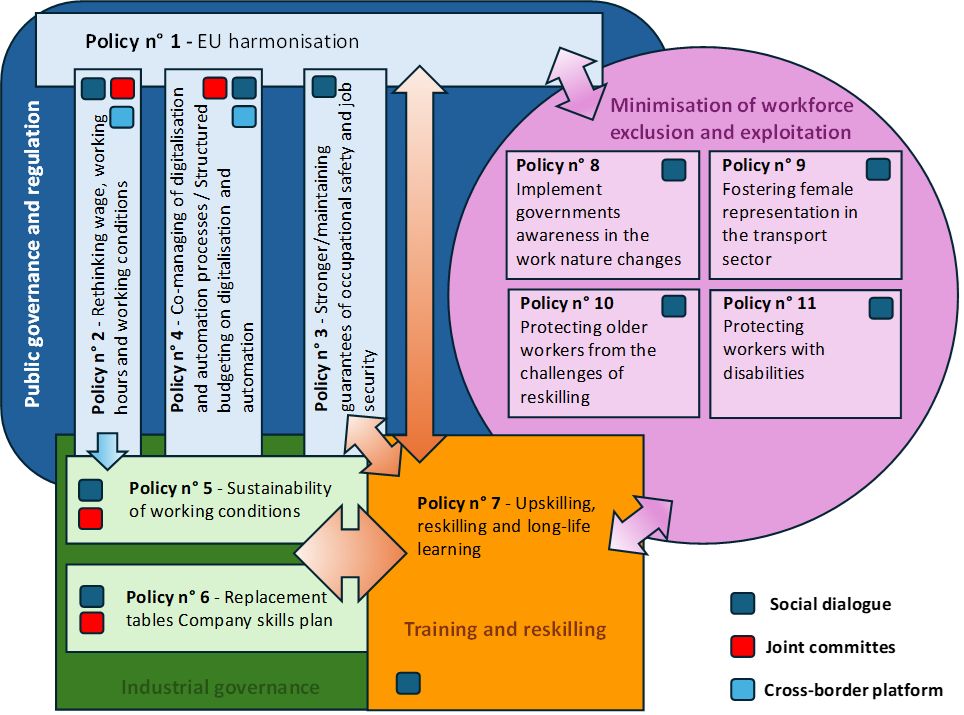
Figure: The structure of the policy agenda (Source: Pronello and Fedeli, 2025)
The proposed policies are interrelated and integrated, as shown in the figure above, demonstrating that none can be addressed independently and that implementation can be simplified through common cross-cutting actions.
All eleven policies were considered to be very urgent, stating that it is necessary to start defining and implementing them now, as their complexity and the difficulty of changing the current paradigm would certainly require time and imply a cultural change.
The WE-TRANSFORM project shows the importance of driving negotiated change during a transition process that must mobilise all stakeholders.
Automation is not an end in itself, and it is important to remember that the aim of the proposed policy agenda is to preserve the competitiveness of European transport companies (regardless of the mode of transport) for the benefit of both customers and industry, while seeking to improve the working conditions of professionals (e.g., by simplifying the complexity of certain tasks, identifying critical skills, not excluding anyone, etc.). Furthermore, the values shared by European countries require that maintaining competitiveness should not be at the expense of human and social aspects: a good transition is also a just transition.
The policy agenda with its eleven policies was recently published (Pronello and Fedeli, 2025) and is available here.
References
Cristina Pronello, Enrico Fedeli, (2025) Just technology transition. A policy agenda to minimise the social impacts of digitalisation and automation on the transport workforce, Transportation Research Interdisciplinary Perspectives, Volume 34, 2025, 101670, ISSN 2590-1982, https://doi.org/10.1016/j.trip.2025.101670.